A Short Window of One Week
Most fruits give you time. Apples cling to their trees for weeks, allowing you to return and pick them at your leisure. Maesil — a Korean plum, though technically closer to the Japanese ume — does not. Once ripe, maesil drop. Not slowly, and not over the course of a month. Within a week of peak ripeness, they fall to the ground, bruise, and ferment in the summer heat.
You learn this quickly.
Upstream on the Boseong River, Daeheung Farm has three maesil trees. One of them — for reasons of rootstock, microclimate, or otherwise — consistently ripens and drops about a week earlier than the other two. So, in practice, the harvest splits: you keep an eye on the early tree in late May, harvest it before it drops, then harvest the remaining two around June 6th.
June 6th — A Timely Holiday
June 6th is Memorial Day — a national holiday in Korea, an observance that honors those who died in service to the country. Schools close, and most offices take the day off. In the cities, it passes quietly.
In the countryside, it’s also annually the best day to pick maesil.
This timing is not planned — it’s where the biological calendar of the maesil fruit and the national holiday align. Around June 6th, the main two maesil trees reach their maximum size, still dark and firm green before they begin to turn yellow. The pit inside has hardened, and the flesh is still firm and unfermented. This is precisely the right moment.
Having a full holiday is useful: harvesting from three trees, washing the fruit, and starting the fermentation process all take several hours. On a weekday, this would mean either before work in the morning or after work in the evening, both difficult with a harvest that won’t wait.
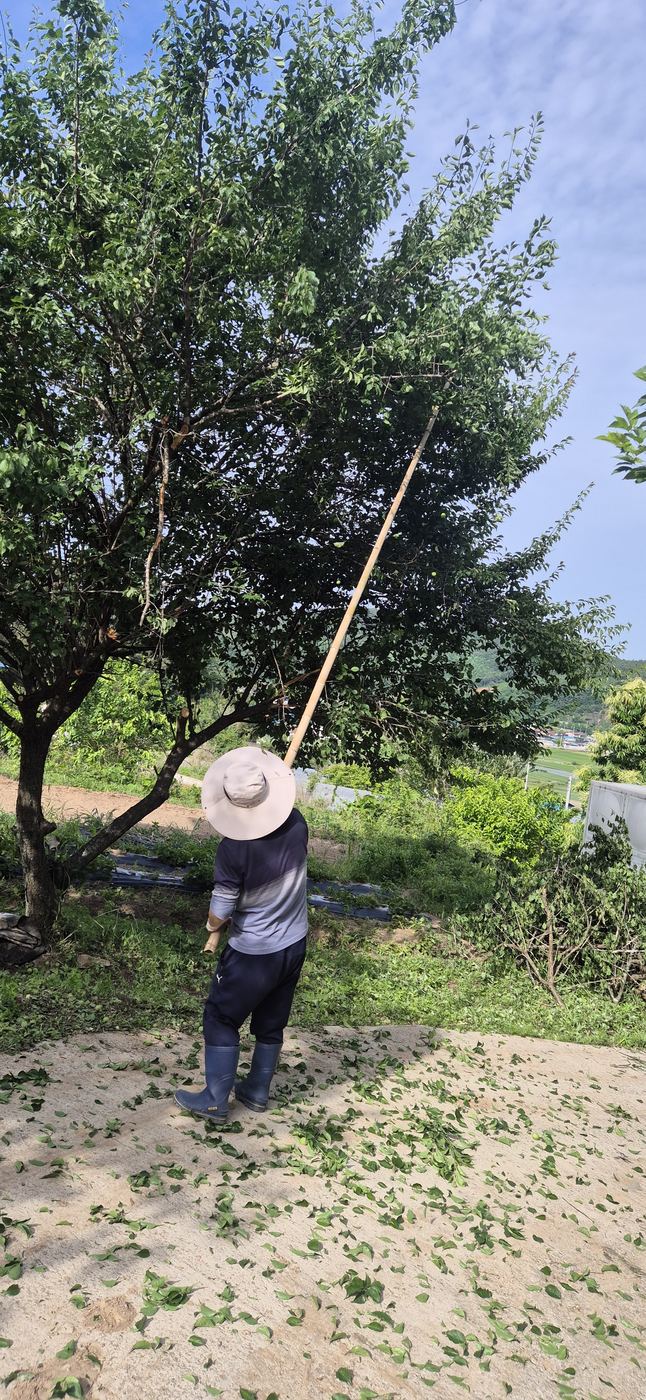
The photo above was taken on June 6th. The long pole is a traditional harvesting tool — extended to reach high branches, then sharply tapped to dislodge clusters. The straw hat is practical: direct Korean summer sunlight at 10 AM is already intense.
How It’s Done
Harvesting: Use a long pole to tap fruit from branches, letting them fall onto a tarp spread beneath the tree. Pick any fruit reachable by hand directly. The maesil should be firm, not soft — soft fruit has already begun to spoil. Dark green is appropriate; a yellowing color means you’ve missed the window, and the fruit is too ripe to store.
Washing and Sorting: The harvested fruit is washed, dried, and sorted. Bruised or cracked maesil are set aside — they can be used immediately for maesil juice or cooking, but won’t withstand the long fermentation process.
Maesil-aekgis (Maesil Extract): The main purpose of the harvest is to make maesil-aekgis — a fermented maesil concentrate created by layering whole maesil and an equal weight of sugar in large glass jars. The mixture is sealed and allowed to ferment at room temperature. Over three to six months, the sugar draws out the juice from the fruit through osmosis, creating a thick, dark liquid with a tart, complex flavor — fruity, sour, and subtly herbaceous.
Maesil-aekgis is used year-round: diluted with cold water in summer, incorporated into marinades, mixed into salad dressings, or consumed in small quantities to aid digestion. In Korean homes where it’s made, bottles from a good harvest last until the next year’s crop. The yield from three trees is ample for a single family’s comfortable use.
Basic ratio: equal parts maesil and sugar by weight. Whole fruit, once dried (and not washed), is packed tightly into sterilized glass jars with no air gaps. Seal. Done. The fermentation requires no further attention — patience is the only remaining ingredient.
In Comparison
In Western culinary traditions, homemade preserved fruit concentrates have almost entirely transitioned to commercial production. Jams are bought, fruit cordials are bought. The connection to how they’re made, and to the moment a specific fruit reaches its peak and must be processed immediately, has largely been lost.
The production of maesil-aekgis in a rural Korean home is still a domestic practice dictated by the fruit’s own schedule. The harvest window is set by the tree, not by the supermarket. The fermentation period is set by biology, not by a product’s expiry date. This resulting product, used over twelve months, links every meal it flavors back to that specific week in early June — to the weight of the jars, the smell of the harvest morning, and the satisfaction of filling and sealing the last container.
It is not complicated at all. The complexity lies, rather, in continuing to do it every year, even when it might be easier not to.
The three maesil trees on Daeheung Farm were planted by the author’s grandfather. The harvest usually takes place on June 6th, before the heat of the day begins, and is done alone.